
| |
FREQUENTLY ASKED QUESTIONS |
| |
|
|
|
|
| |
Q: |
Why go to culinary school? What can I expect to learn? |
|
 |
| |
A: |
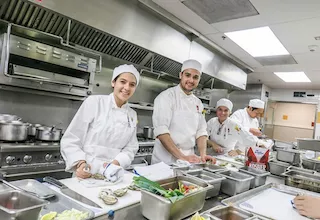
Sometimes
prospective students ask us why they should enroll in culinary school.
Why not simply find a good restaurant and learn on the job? While working
in a restaurant helps you assess whether the field is indeed for you,
a drawback to on-the-job training is that your culinary education is
limited to the repertoire of a single employer. Moreover, you may learn
the hows of cooking by working in a restaurant, your employer probably
wouldn't have time to teach you the whys of cooking. That's where culinary
school comes in. We consider questions such as Why does a sauce
break? Why does a cake fall? What makes a stock cloudy? |
|
| |
|
|
|
| |
Q: |
What can I do with a culinary diploma? |
|
| |
A: |
The
food-service field is one of the fastest growing job sectors in the
United States today, and employers increasingly see a culinary school
diploma as an essential credential for a job in their kitchens. But
working as a food professional can mean more than just working in a
restaurant. Other possibilities include catering, hotel and restaurant
management; publishing and television; private and corporate dining;
specialty food retailing; food styling; wholesale and retail baking;
food and beverage consulting; freelance food writing; and recipe development. |
|
| |
|
|
|
| |
Q: |
How long will it take me to earn a diploma? |
|
| |
A: |
The Culinary Arts program runs 650 hours-440 hours in class and 210 hours on externship. The Pastry and Baking Arts program runs 610 hours-400 hours in class and 210 hours on externship. The Culinary Management
Diploma program runs 316 classroom hours. In all cases, a single class lasts four hours. Schedules are varied, allowing you to take classes two, three, four or five times a week. Because of these schedule options, total program length ranges from 28 to 43 weeks. |
|
| |
|
|
|
| |
Q: |
Can you describe the students? |
|
| |
A: |
Applicants must have a high-school diploma
or GED. They come from all over the United States and the world, including
countries such as Brazil, the Philippines, Israel, England and Korea,
and from all walks of life. Their average age is 26. |
|
| |
|
|
|
| |
Q: |
Do I have to have culinary experience
before I enroll? |
|
| |
A: |
No.
Some of our students are at the start of their working lives, dreaming
of becoming executive chefs
in the nation's top restaurants. Others have already worked in professional
kitchens and are seeking a way to deepen their knowledge and advance
their careers. Career changers, too, have long made up an important part
of our student body. Among our graduates are former lawyers, medical
technicians, bankers, computer programmers, truck drivers, carpenters,
journalists and actors. |
|
| |
|
|
|
| |
Q: |
How much does school cost? Is financial
aid available? |
|
| |
A: |
Currently, Culinary Arts tuition is $28,017, Pastry and Baking Arts tuition is $26,334 and the Culinary Management Diploma program costs $12,900. We offer a variety of financial aid options, including those offered by Sallie Mae (SLM Financial Corporation) and Wachovia Education Loans. The loan perioed is from one to twenty years and can include up to 100 percent of a student's tuition (subject to credit approval). Information and applications can be obtained from the admissions department. |
|
| |
|
|
|
| |
Q: |
Can students take two programs at the same time, and is there a discount for doing so? |
|
| |
A: |
Yes, our schedules are arranged so that
students may take a cooking or baking program and the Culinary Management
Diploma program concurrently, e.g., morning and afternoon or afternoon
and evening. A 25% tuition discount is offered on the CMD program if
enrollment is concurrent with a Culinary Arts or Pastry and Baking Arts
program. |
|
| |
|
|
|
| |
Q: |
How will I find a job when I've finished? |
|
|
| |
A: |
Our
Department of Career Services makes sure job placement is available
to all graduates and alumni. While in
the program, you will benefit from job fairs, résumé workshops,
seminars, individual advisement sessions and volunteer opportunities.
We maintain extensive job listings, from entry-level to advanced positions,
through our established network of graduates, chefs and other culinary
contacts in New York City and elsewhere. Alumni have access to a weekly
email that lists a wide range of job opportunities at all levels. |
|
|
| |
|
|
|
|
| |
Q: |
Why go to the Institute? |
|
|
| |
A: |
We
are very proud of the institution we have built and could answer that
question in many ways.
But there is one external document that we feel says a lot. The Institute
received accreditation from the Accrediting Commission of Career Schools
and Colleges of Technology in October 1999. Prior to that, an ACCSCT
team made up of industry experts and educational experts visited the
Institute for a two-day inspection. In their report, the accrediting
team cited the Institute of Culinary Education for four separate "Items
of Excellence":
- 100% student satisfaction: all students surveyed would "recommend the school to a friend"
- Outstanding faculty and faculty
commitment to students
- The school's facilities and equipment
- The school's involvement in community service
|
|
|
| |
|
|
|
|