New! Enjoy a personal tour of ICE 7 days a week
flexible morning & evening hours too!
|
 |
|
|
|
|
|
|
|
|
|
|
|
|
|
|
| |
PASTRY & BAKING ARTS DIPLOMA:
PROGRAM CURRICULUM OUTLINE |
| |
|
|
|
| |
|
|
|
| |
The diploma program
contains five modules. The first four modules are comprised
of 100
four-hour lessons that are held at the Institute.
The fifth module is an off-site externship. The
program is constructed as follows: |
|
 |
| |
|
|
| |
MODULE 1 : 100 Hours
Course 1: Introduction to Baking Techniques
and Ingredients
The program begins by giving students an in-depth understanding of the
ingredients, techniques and procedures they will use throughout the program:
• Identification and discussion of the four essential ingredient groups:
dairy, fruit, flours and chocolate.
• Cost analysis, weights and measures, culinary math, food safety, sanitation
and equipment identification.
• Introduction to basic decorating skills, the use of a pastry bag and
making and utilizing cornets.
• Techniques for preparing fruit-based desserts, including paring, poaching,
roasting, macerating, drying and candying.
Course 2: Introduction to Baking Techniques
and Ingredients
All well-executed desserts rely on a mastery of fundamental techniques. In this
course, students begin the journey toward that goal by learning:
• The basics of egg theory as they prepare egg-based desserts like crème
brûlée, bread pudding, soufflés, mousses, meringues and éclairs.
• The theory and practice of sugar cookery, including the preparation of
sugar syrups, glazes, fondant, nougat and caramel.
• How to prepare a variety of cheesecakes along with classic pastry cream
and pâte à choux.
• Production of frozen desserts such as ice creams and sorbets.
MODULE 2 : 100
Hours
Course 1: Breads and Other Yeast-Raised Doughs
Bread is at the crossroads of the culinary and baking arts. At the heart of this
deceptively simple food is some of the program's most challenging material.
• The technique and theory of working with yeasted doughs: fermentation,
dough hydration, temperature control, kneading and formation methods.
• How to calculate and utilize bakers' percentages, as well as sponge,
sour and straight dough formulations.
• Application of this theoretical knowledge by baking a variety of breads,
including braided, rye, olive and sourdough loaves along with brioche, bagels,
baguettes, foccacia and pizza.
Course 2: Pastry Doughs
Mixing, rolling, turning and forming: these are the essential skills students
master as they learn to prepare the wide variety of doughs that are the basis
of so many pastry items. Included are:
• The trio of classic doughs: pâte brisée (flakey), pâte
sucrée (sweet) and pâte sablé (cookie) to make individual
tarts and pastries.
• Laminated or layered doughs, including puff paste, croissant and Danish
doughs, both by hand and with the use of a commercial sheeter.
• Proper rolling techniques for preparing tarts, galettes, pies (single-crust,
two-crust and lattice), palmiers, mille-feuille, fruit strips, pithiviers, croissants,
pains au chocolat and a variety of Danish specialties.
• Specialty pastry shop items including phyllo, donuts, cannoli, sfogliatelle
and hand-stretched classic strudel.
MODULE 3 : 100
Hours
Course 1: Cakes, Fillings and Icings
From the humble pound cake to the classic genoise, students go beyond the recipes
to explore the theory and technique of cake making and their abilities to create
original cakes. Students will learn:
• Butter-based and egg-foam cakes, including a variety of layered and rolled
versions.
• The theory of batter balance as they prepare cakes using various mixing
techniques: one-stage, high-ratio and creaming method. Cakes prepared include
carrot, pound, white, yellow, crumb, chocolate along with muffins. Low-fat and
egg-foam cakes such as angel food, chiffon and genoise are also included.
• Icings and fillings such as curds and ganaches as well as both Swiss
and Italian meringue-based buttercreams.
• How to form, glaze and decorate petits fours.
Course 2: Advanced Cakes, Cookies and Plated Desserts
Batters produce more than the familiar cakes we often see: more complex techniques
give us not only an international assortment of cakes, but cookies as well. Covered
here are:
• Complex layered goods including plain and chocolate-nut sponges, genoise,
mousseline, pan di Spagna and biscuit joconde.
• A classic assortment of cakes, including opera, miroir, tiramisu, zucatti,
zuppa Inglese, charlottes and chocolate ribbon cakes.
• A wide variety of piped, dropped, molded, bar, sheet and stencil cookies
including biscotti, brownies, madeleines, macaroons, spritz, tuile and tulipe.
• Theory, preparation and presentation of multi-element, contemporary plated
desserts.
MODULE 4 : 100
Hours
Course 1: Cake Decorating
Cake decorating represents the ultimate fusion of art and craft.
The students' effort
and practice in prior classes is rewarded as they take their skills to a new
level by preparing tiered cakes. Students learn:
• Buttercream flowers and borders, royal icing, fondant (draping, crimping
and ruffling) and gum paste flowers.
• Floral arrangement and tiered cake assembly including splitting, filling
and crumb coating, and the useage of marzipan for covering cakes and making flowers.
• Finishing techniques like petal dusting and tier assembly. This course
culminates in the creation of an original wedding cake.
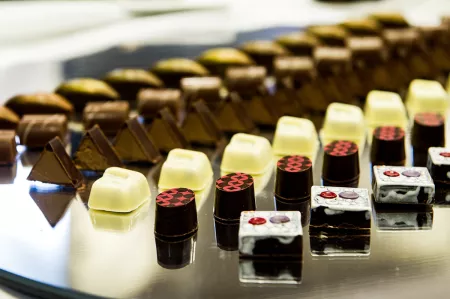
Course 2: Chocolate Confections
Of the various media used by pastry chefs to express their vision, none is more
seductive than chocolate. This comprehensive course takes students beyond the
basic techniques and allows them to experience the joy of creativity as they
produce a show piece of their own design. Students will learn:
• Chocolate production, theory and tempering methods.
• Dipping and enrobing.
• Preparation of fudge, fondant, truffles, butter crunch, nougatine, molded
chocolates, dipped and liquid-filled chocolates, chocolate baskets and - the
highlight of this section -showpieces.
• Advanced methods including piped and framed centers, chocolate plastique,
pastillage and isomalt casting.
MODULE 5 : 210
Hours
Externship
At the end of their in-class training, all students are assigned an externship.
While The Institute of Culinary Education strongly recommends that students extern
in restaurant kitchens, they may request other venues such as hotels, catering
companies, corporate dining rooms, test kitchens or food magazines in order to
meet their professional goals. |
|
| |
|
|
| |
WINE STUDIES AND SPECIALTY CLASSES
In addition to
the diploma program, all career students are given the opportunity
to take the Institute's six-session Wine Essentials
class and three single-session specialty classes as part
of their education. Specialty classes cover an array of
cuisines and topics and are offered days, nights and weekends.
They are listed in The Main Course. |
|
| |
|
|
|
|
|
|
|
|
|
|
|